My research focuses on understanding the formation and evolution of galaxies within their cosmic environment,
particularly in the early Universe. By analyzing distant galaxy clusters and protoclusters at z ~ 2,
I investigate the physical processes that drive galaxy growth, the role of large-scale structure, and the
interplay between star formation, supermassive black holes, and gas dynamics.
I specialize in using multi-wavelength data, combining integral field spectroscopy (IFS) and high-resolution
imaging to probe the interaction between galaxies and their surroundings. Through observations with instruments
such as KCWI, HST, and MUSE, I analyze gas kinematics, feedback from active galactic nuclei (AGN), and
the presence of diffuse intracluster light (ICL) as an indicator of early structure formation. My work also
involves numerical simulations and cosmological models to interpret observational data and provide a theoretical
framework for galaxy evolution studies.
A significant part of my research is dedicated to the circumgalactic and intergalactic medium (CGM/IGM),
exploring how galaxies exchange gas with their environment. By studying Lyman-alpha emitting galaxies and
their extended gaseous halos, I place constraints on the cosmic ultraviolet background (UVB) and the distribution
of matter in the large-scale structure of the Universe.
My work is highly interdisciplinary, spanning astrophysics, cosmology, and data science. I actively collaborate
with international teams to develop innovative observational strategies and analytical techniques. Additionally,
I am committed to science communication and public outreach, integrating astronomy with broader cultural and
educational initiatives to make complex scientific concepts accessible to diverse audiences.
13 peer-reviewed papers, 1 preprint under review and 3 AI safety reports. Also on Google Scholar and ORCID.
Papers and reports
Every paper has its own entry with a short summary, the main results and links to read or cite it. Choose a topic to narrow the list.
Alongside astronomy, part of the work at CosmoVentures looks at how AI systems are overseen and contained. These reports come from Apart Research sprints: early results, shared openly.
2026
First authorLatestPreprint submitted to Astronomy & Astrophysics · 2026
Sofia G. Gallego, Simona Mei, Emanuele Daddi, Gaël Noirot, Dominika Wylezalek & R. Michael Rich
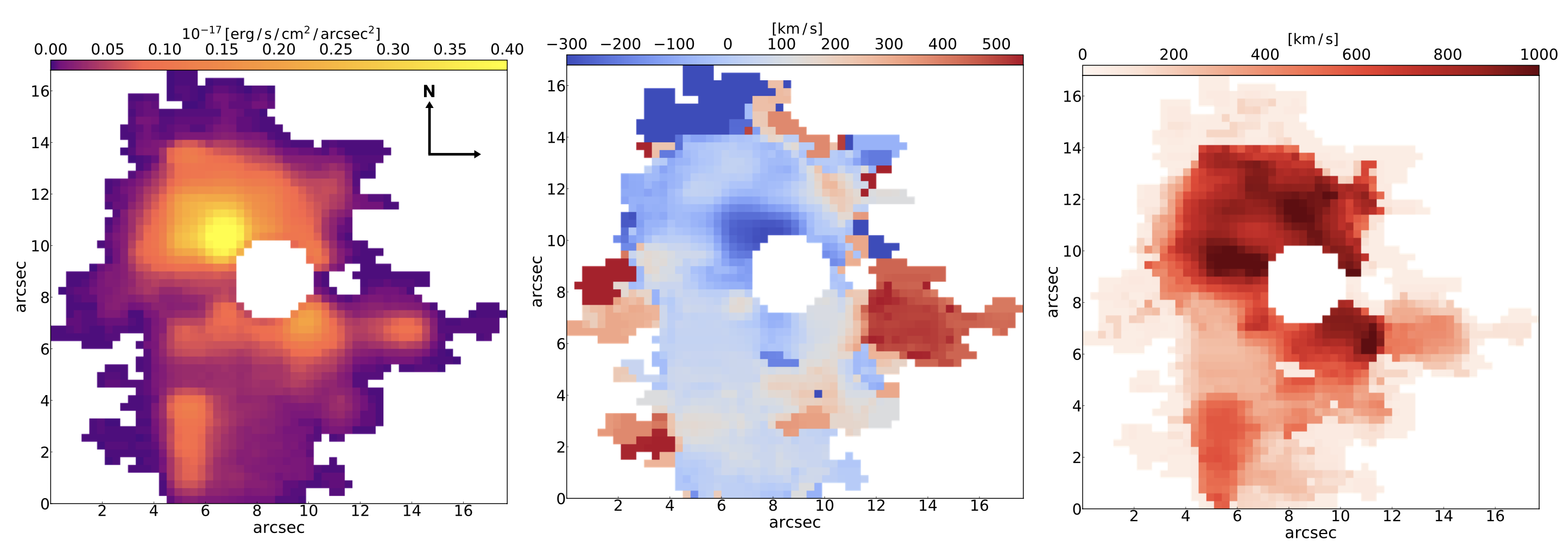
A quasar at the heart of a forming galaxy cluster shows almost no glowing gas around it. The gas lights up a little further away, along a tidal stream of stars and galaxies caught in the middle of merging.
Clusters and protoclustersQuasars and AGNCircumgalactic and intergalactic gas
With Muhammad Shoaib Altaf, Devesh Sawant and Xin Li.
Replaying a real sandbox escape from July 2026, the team compared one monitor, four identical monitors and four reviewers with distinct roles. Specialised reviewers held containment on more unsafe steps, yet every set-up shared the same blind spot.
Little Agent Lab as a research piece: a browser game in which you build a team of AI agents and keep a secret from leaking, making oversight and verification tangible for younger players.
Does asking one model to reason as several personas widen what it considers? Across real cases, more varied answers did not lead more often to the decisive explanation.
MUSE follow-up of four giant Lyα nebulae at z ≈ 3 revealed two smaller satellite nebulae, each about 300 kpc from its main nebula and at nearly the same velocity.
Circumgalactic and intergalactic gasClusters and protoclusters
Sofia G. Gallego, Simona Mei, Christopher Martin, Donal O’Sullivan, Emanuele Daddi, Dominika Wylezalek & Nicholas Seymour
Deep KCWI observations reveal a Lyα halo at least 128 kpc across around a radio-loud quasar in a dense environment at z = 2.8, and look at what shapes it.
Clusters and protoclustersQuasars and AGNCircumgalactic and intergalactic gas
A disk galaxy at z = 3.25, two billion years after the Big Bang, is far larger and more massive than other early disks and resembles the biggest disks of today.
Vivienne Langen, Sebastiano Cantalupo, Charles C. Steidel, Yuguang Chen, Gabriele Pezzulli & Sofia G. Gallego
Hα emission detected around a quasar at z ≈ 2.2, next to its Lyα nebula, helps to constrain the density and motion of the gas in the circumgalactic medium.
Circumgalactic and intergalactic gasQuasars and AGN
A new and independent way to constrain the cosmic UV background: the faint Lyα glow of self-shielded gas clouds that it illuminates, detected by stacking MUSE data.
Cosmic web and UV backgroundCircumgalactic and intergalactic gas
Sebastiano Cantalupo et al. (including Sofia G. Gallego)
Deep MUSE He II observations of the Slug Lyα nebula point to intergalactic gas that is clumpy and spread over very large distances along the line of sight.
Circumgalactic and intergalactic gasQuasars and AGN
Simulations of a small satellite galaxy falling into the inner 200 parsecs of the Milky Way test whether it could have fuelled the past activity around the central black hole.
My current research explores the formation and evolution of large-scale structures in the early universe,
focusing on galaxy clusters and protoclusters. Lately, I've been interested in understanding the connection between
intracluster light (ICL) and cluster/protocluster environments.
Co-evolution of Galaxies and their Environment at Cosmic Noon
Investigating the interplay between galaxies and their large-scale environment at z~2, analyzing gas dynamics,
AGN feedback, and intracluster light using KCWI and HST data to understand the early assembly of cosmic structures.
Bachelor’s Research:
My undergraduate research focused on the dynamics of gas inflow into the inner ~200 pc of the Milky Way,
analyzing how a satellite galaxy merger perturbs the gas distribution in the Galactic Center. Using
hydrodynamical simulations, I studied how gas is funneled toward the central region, leading to
possible star formation and activity near the supermassive black hole, Sagittarius A*.
This work contributed to understanding the role of minor mergers in fueling central black holes
and shaping the Milky Way’s inner structure.
I continued working on this topic during my Master’s research, refining the dynamical models
and incorporating additional simulation constraints. This effort led to a published paper in
MNRAS Letters, providing key insights into how satellite galaxy infall influences gas dynamics
in the Galactic Center (MNRAS Paper).
Master’s Research:
My research thesis focused on detecting galaxy clusters using the red-sequence technique in the
CFHTLS/VIPERS surveys, characterizing their optical properties and estimating cluster masses via
optical richness (Master’s Thesis).
This work refined photometric cluster detection methods and provided constraints on the mass distribution
of galaxy clusters at intermediate redshifts.
In addition to my thesis, I worked on a small project where I developed my own radiative transfer code
to simulate supernova (SNe) polarization, investigating how asymmetries in the explosion mechanism and
dust scattering affect observed polarization signals ([Link]). This allowed for a deeper understanding
of how explosion geometry influences SNe light curves and polarization profiles.
Additionally, I completed a semester project analyzing tidal tails in globular clusters, identifying stellar streams
to help model the Galactic center potential. This work contributed to understanding how globular clusters
dynamically interact with the Milky Way's gravitational field, providing insights into both the evolution
of clusters and the underlying mass distribution of the Galactic center.
Ph.D. Research (ETH Zurich):
My main focus during my Ph.D. at ETH Zurich was unveiling the properties of the cosmic web
through Lyman-alpha emission. To achieve this, I developed a specialized stacking technique
aligning MUSE integral field spectroscopy observations of Lyman-alpha emitters to detect
the faint filamentary structures of the cosmic web in emission for the first time.
This method provided new observational evidence of large-scale intergalactic gas distribution,
allowing for a direct connection between galaxies and their surrounding environment.
Building on this detection, I then used the same data to constrain the intensity of the
Cosmic Ultraviolet Background (UVB) in low-density regions of the cosmic web, placing new
limits on how extragalactic ionizing radiation regulates intergalactic gas properties.
My work bridged the gap between theoretical predictions and observational constraints on
cosmic web emission, revealing key insights into how diffuse intergalactic gas is ionized,
distributed, and connected to galaxy evolution in the early universe.
(Ph.D. Thesis).
Postdoctoral Research (Caltech):
At Caltech, I studied a high-redshift (z=2.3) protocluster system using KCWI integral field
spectroscopy, uncovering multiple extended Lyα halos surrounding galaxies in a dense environment.
My research provided new evidence of AGN-driven outflows and enhanced star formation within
overdense regions of the cosmic web.
I integrated multiwavelength datasets (ALMA, HST, Spitzer, Chandra) to probe the interplay between
gas kinematics, galaxy evolution, and AGN-driven processes. My findings contributed to understanding
how feedback from supermassive black holes influences galaxy growth in the early universe,
particularly in environments that will evolve into massive clusters by z=0.
During my time at Caltech, I also collaborated with Prof. Shinsuke Shimojo's behavioral neuroscience group
on exploring volition and sense of agency as a dimension for the flow state.
Postdoctoral Research (Université Paris Cité):
Currently, I am investigating several protoclusters from the CARLA survey, a sample of high-redshift
structures centered on radio-loud AGNs. My research focuses on gas kinematics, AGN-driven outflows,
and the emergence of intracluster light (ICL), key components in understanding cluster formation at
Cosmic Noon (z~2).
By combining HST, KCWI, and multiwavelength observations, I am examining how dense environments
shape galaxy evolution and trigger enhanced AGN activity. My work contributes to characterizing
early-stage cluster formation, identifying mechanisms that regulate star formation and gas accretion
in the progenitors of today’s massive galaxy clusters.